Atom-Centered Symmetry Functions
A fundamental problem with the use of neural networks for the construction of high-dimensional potential-energy hypersurfaces is the generation of suitable input features with which the networks can be fed. The raw coordinates are unsuitable for several reasons, as pointed out by J. Behler [2]: Translations or rotations of a system are energy-conserving operations, regardless of the change in the absolute coordinates. However, this condition wouldn’t be strictly fulfilled for networks that are trained on the absolute atomic coordinates. Otherwise the network would be fitted to potentially contradicting data, since two different inputs would have to lead to exactly the same output (i.e. total energy). The same reasoning applies to the exchange of two atoms of the same type as well as the requirement for a constant number of input features, regardless of possibly changing coordination numbers (i.e. during MD simulations).
Therefore Fortnet implements the so-called Atom-centered Symmetry Functions (ACSF) [2], proposed by J. Behler as a possible choice of symmetry mappings, listed below:
radial functions:
angular functions:
Please note that currently only an automatic generation scheme is available via the HSD input. An explanation of this parameter generation can be found in the following section.
Automatic Parameter Generation
The automatic ACSF parameter generation scheme aims to cover the cutoff sphere as evenly as possible, with the number of symmetry functions available [10]. The user HSD input is already known from the introductory sections and looks similar to this:
Mapping = ACSF {
  NRadial = 10
  NAngular = 8
  RCut = 4.0
}
The corresponding parameters are then generated based on the number NRadial
of \(G^2\) and the number NAngular of \(G^5\) functions specified,
as well as the cutoff radius RCut in Angstrom.
Radial Parameters
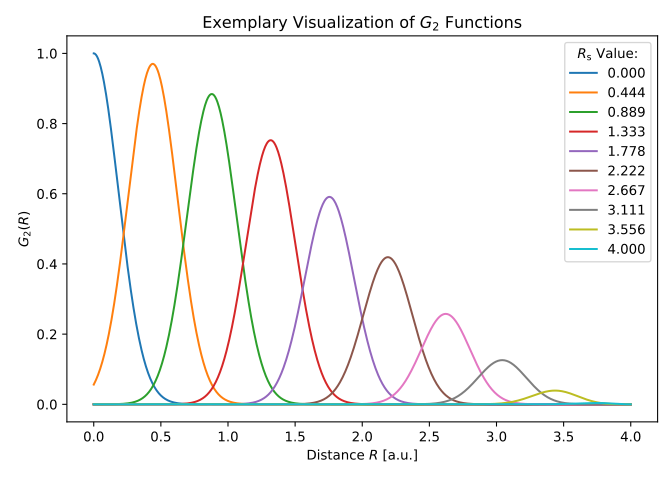
The \(G^2\) function is used as radial mapping, therefore sensible values for the peak position \(R_\mathrm{s}\) and width \(\eta\) of the Gaussians are to be determined. \(R_\mathrm{s}\) is chosen to go from 0 to \(R_\mathrm{c}\) in equidistant steps. The width evaluates to the following more or less arbitrary equation:
The figure below shows the \(G^2\) functions resulting for the HSD input example above:
Angular Parameters
The \(G^5\) function is used as angular mapping, therefore sensible values for the pre-factor exponent \(\xi\), \(\lambda\)-parameter and width \(\eta\) of the Gaussians are to be determined. \(\xi\) is chosen to go from 1 to 16 in equidistant steps, in order to obtain functions that are strictly separated from one another. The width, again, evaluates to the following more or less arbitrary equation:
Last but not least, the parameter \(\lambda\) alternately takes the values -1 and 1, as suggested by the original ACSF paper [2]:
Atom-Specific Scaling Factors
One possible extension of the ACSF mappings is the incorporation of external atomic scaling factors \(q_j\), hereinafter referred to as atom identifiers, in the cutoff function \(f_\mathrm{c}\):
In addition to the structural information, atom-specific features can thus be taken into account. A reasonable choice for the atom identifiers would be, for example, the Mulliken populations from a quantum mechanical simulation of the system.
The atom identifiers are extracted from the external atomic features provided by
the dataset. To do so, the dataset must provide at least one external feature
per atom to choose and an appropriate entry in the External HSD-block of the
user input has to be set:
External {
      .
      .
      .
  AtomID = 1
}
The integer index corresponds to the atomic feature of the dataset to extract and must take a value between one and the number of features per atom provided.
Multi-Species Systems
A modification of the ACSF can be useful for datasets that contain systems with several atom types. In the form as listed above, no distinction is made between different species, which is why the resulting values do not depend on the species of the atoms contained in the cutoff sphere, defined by \(R_\mathrm{c}\).
To overcome this limitation, Fortnet offers the possibility to specify
so-called species identifiers in the External block of the fortnet_in.hsd
input file:
External {
      .
      .
      .
  SpeciesID {
    C = 0.364302
    Si = 0.247609
  }
}
The default value of the species identifier is 1.0. Element-specific properties such as the Hubbard \(U\) of the DFTB method are particularly suitable. The identifiers are then used as a pre-factor in the cutoff function \(f_\mathrm{c}\) and are therefore included in all ACSF:
These species identifiers are compatible with the atom identifiers. If both are provided, the corresponding scalings are multiplied in the cutoff function.